By Kaden Leeper – About a month ago, there was a somewhat lively debate amongst us here in the shop about whether or not we would be having a steelhead season on the Lower Deschutes this year. Trying to set expectations very low for my colleagues who–and I think they would agree with this statement–are completely steelhead-obsessed, I pessimistically stated that I thought we would have a season this year, though a meager one at best. I am very happy to (cautiously) say that I seem to have been woefully incorrect!
Background
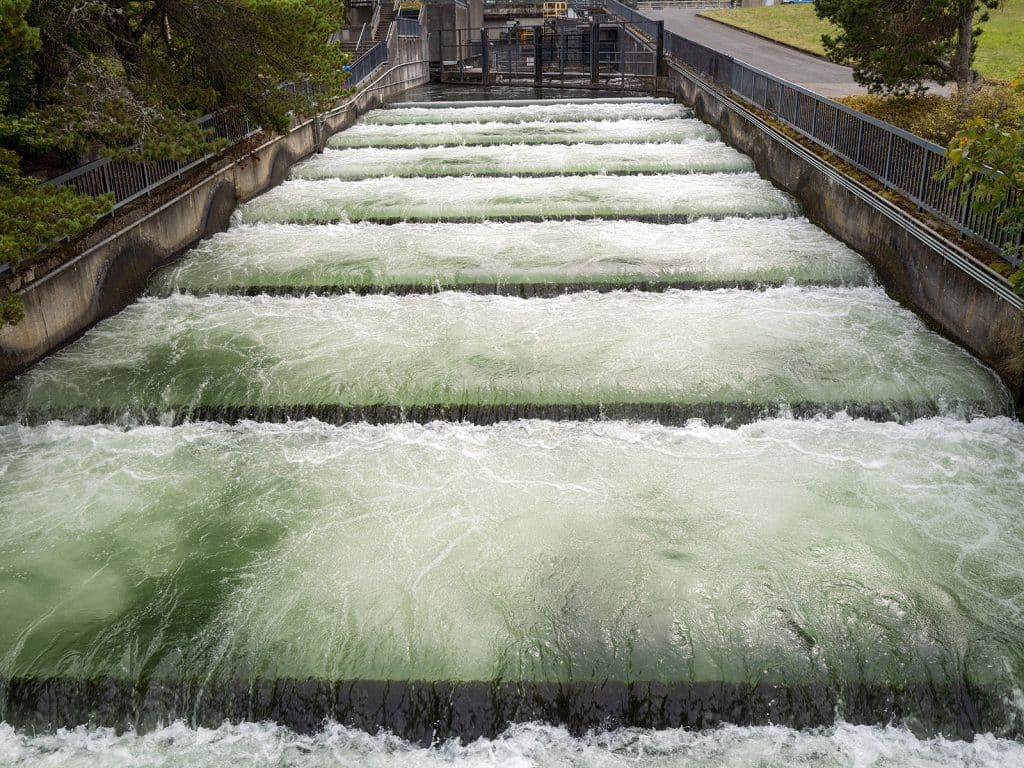
Since 1938, scientists and engineers have kept tallies for each species that passes through the fish ladder at the Bonneville Dam–the first of fourteen such dams on the mainstem of the Columbia River. While it is impossible to track which rivers these fish will eventually go up to perform their spawning duties, the more fish that go over the dam, the more fish will end up in each of the major rivers they run up. In Oregon, the main rivers these fish make their way to are the Deschutes, John Day, Umatila, and Snake. On the Washington side of the river, anadromous (ocean-going) fish like salmon and steelhead tend to end up in the Klickitat, Lewis, Yakima, and Cowlitz River among others. Such tallies are also kept at the other dams the river flows through as it stretches its way north through Washington and into Canada.
Historically, steelhead returns numbers have varied: between 1938 and 1980, numbers generally ranged between 100k and 200k, with a low of 85k in 1975 and a high of 260k in 1952. The average year during this time saw about 110k-140k over Bonneville Dam. This all seemed to change in 1983 when some hypothetical flip was switched and we started seeing over 200k fish consistently every single year! In the 26 year period between 1983 and 2009, 14 of those years saw over 300k steelhead pass over Bonneville, with two of those years (2001 and 2009) seeing 633,073 and 604,970 respectively! While other steelhead and salmon populations started to decline due to habitat degradation, lack of access to spawning grounds, and commercial fishing, the opposite seemed to be happening to the anadromous fish in the Columbia River Basin.
Unlike salmon, steelhead do not necessarily die after spawning. In fact, steelhead can spawn up to four times during their lifetime, with the typical timing between runs being 3-5 years. For this reason, if you have a really good run one year, you can expect another really good run year in 3-5 years when many of those fish come back to spawn in addition to fish spawning for the first time.
In December of 2009, Portland General Electric–who, along with the Warm Springs Nation, owns and operates the Pelton-Round Butte Dam Complex–installed a “mixing” tower in the reservoir at Lake Billy Chinook. While attempting to stay as politically neutral as possible so as not to make a certain group of people rather furious, I will simply state that there has been a meteoric downfall in steelhead returns since its installment. Is there a correlation? I will leave that up to you to decide.
Regardless of what one’s opinion on the mixing tower may be, the facts cannot be disputed. After the second-highest steelhead return in recorded history (604,970) in 2009, the number of returning fish had dropped to a record-low of 77,319 by 2019. This record did not stand, however, as it was quickly surpassed in 2021, which saw a dismal return of 71,980 and a closure of steelhead fishing in the Lower Deschutes for the first time since 1978.
The Present
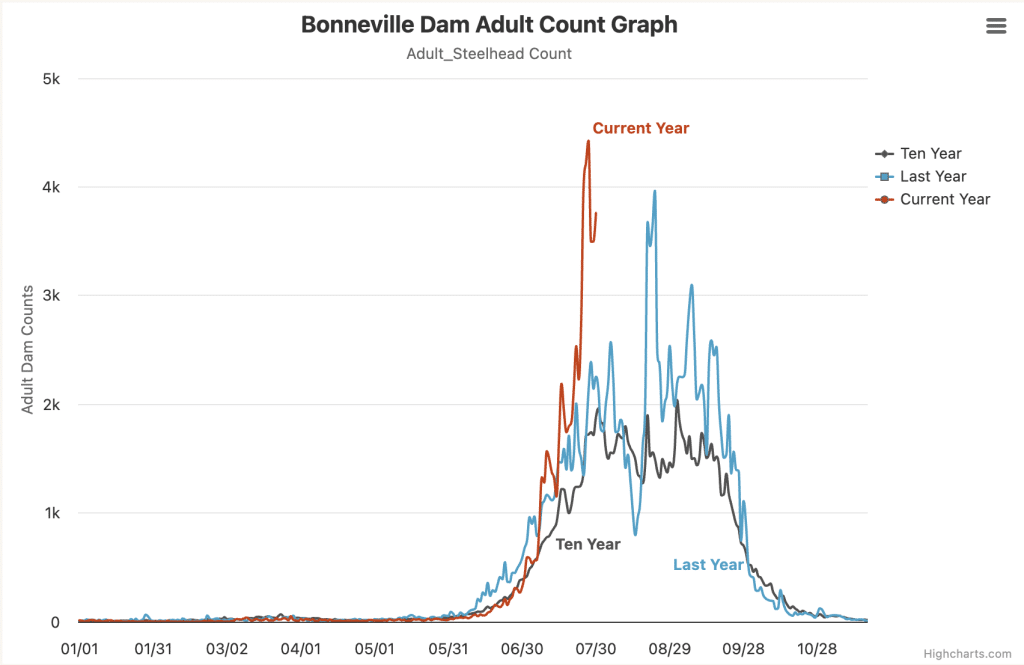
After a relatively solid run last year of 181,000, hopes had been reasonably high to make it two in a row, yet early returns over Bonneville did not look ideal (at least in my eyes). This has since changed! The last week has seen an average of 4,000 steelhead pass Bonneville, with the year-to-date total sitting at 63,190! This is actually higher than last year at this point in the year!
Fish will continue migrating up the Columbia throughout August and September, with the peak number of fish in the system most likely occurring in late-September and early-October. Once November comes around, it is a good idea to stop targeting these fish as they are getting ready to spawn or actively spawning.
Our steelhead flies are starting to roll into the shop, our two-handed line collection is extensive, and we’ve got a solid selection of spey rods for all budgets and skill levels!